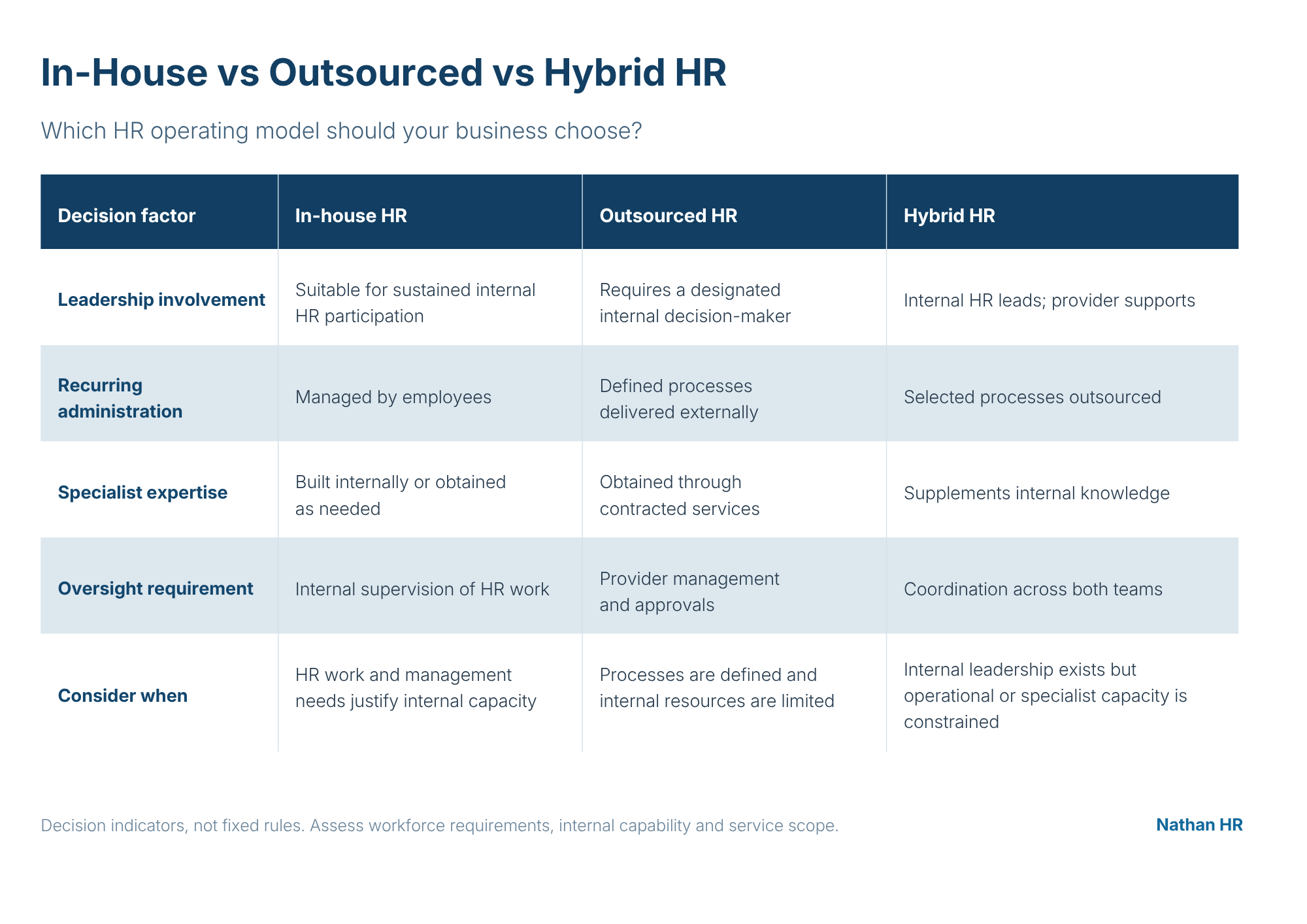
An HR function can be managed by an internal team, an external provider or a combination of both. The right structure depends on the decisions your business needs to retain, the work your employees can deliver and the specialist support required.
An in-house model suits businesses requiring sustained HR involvement in management decisions. Outsourcing can suit organisations with defined HR processes and limited internal capacity. A hybrid model combines internal HR leadership with external support for selected activities.
For UAE businesses, the assessment should cover employee relations, workforce planning, payroll, employment administration and the authorities governing different employee groups.
Start by separating three questions: who is accountable for an outcome, who has authority to approve decisions and who performs the work. These responsibilities determine how an HR function should operate, regardless of where the work is delivered.
Three HR Operating Models
In-house HR means employees manage most HR activities. An internal function can range from one generalist to a department with recruitment, employee relations and payroll specialists.
Outsourced HR means an external provider delivers agreed activities, from payroll processing to broader HR administration. Under conventional HR outsourcing, the business remains the employer and retains its applicable obligations.
Hybrid HR combines internal HR employees or leadership with external delivery of selected processes. For example, an HR manager can oversee employee relations and workforce planning while a provider processes payroll.
Company size alone should not determine the model. The complexity of employment arrangements, management requirements and available expertise are equally important.
What Should Remain Under Internal HR Control?
Even when operational work is outsourced, businesses need an authorised person to make employment decisions and oversee provider performance.
Responsibilities that often benefit from direct internal ownership include workforce planning, hiring approvals, performance expectations, sensitive employee relations decisions and organisational policy.
External specialists can advise on these activities. The business should still document who makes the decision, who supplies information and who records the outcome.
If there is no HR department, a director or another designated manager can serve as the internal contact. That person needs sufficient authority and time to approve employee changes, respond to escalations and coordinate with the provider.
Managers should also know where to direct employee requests, who handles confidential information and when an issue requires leadership involvement.
Which HR Activities Can Be Outsourced?
Payroll is one candidate. An external provider can calculate salaries, prepare payroll outputs and perform agreed administration. HR or finance should supply accurate employee information, review exceptions and authorise payment through the employer's procedures.
In the UAE, employers must account for wage-payment requirements applicable to their establishment. The UAE Government provides guidance on the Wage Protection System (WPS) for establishments within its scope. Requirements should be checked against the relevant employment authority.
Other activities suitable for external delivery can include employee documentation, onboarding administration, recruitment coordination and specialist HR advice.
Outsourcing has operational limits. A provider needs timely information, defined access to systems and an internal contact able to resolve exceptions. Frequent last-minute changes or poorly defined approvals can undermine an otherwise suitable arrangement.
Before outsourcing a process, identify its inputs, required outputs and dependencies. A payroll provider, for instance, needs an agreed method for receiving attendance records, salary adjustments and employee changes before processing begins.
How a Hybrid HR Model Works
Consider a UAE company with an HR manager responsible for employee relations, recruitment decisions and workforce planning. The company could engage an external provider for payroll and selected administrative processes.
Its HR manager would approve employment changes and supply employee data. The provider would complete the agreed processing, while an authorised employee would review the outputs. Finance could reconcile payroll costs and coordinate payment approval.
An international company establishing a UAE operation might instead retain regional HR leadership and obtain local support for payroll and employment administration.
Both examples illustrate the distinction between accountability, authority and delivery. A provider can perform a process without becoming the decision-maker for the employer.
The hybrid arrangement should also identify which system holds employee records, who updates those records and how changes reach the external provider. This reduces dependence on informal messages and individual employees.
How to Choose Your HR Structure
Assess six factors before selecting a model.
1. Leadership Involvement
If HR decisions require frequent participation in management discussions, maintain sufficient internal capability. External advisers can supplement specialist knowledge.
Consider whether management needs regular support with employee performance, workforce planning or organisational changes. These requirements can justify dedicated internal HR capacity.
2. Operational Workload
Identify the time spent on payroll, documentation, onboarding and recurring employee requests. Defined, repeatable work can be considered for external delivery.
Review the volume and complexity of each process, not only employee numbers. Frequent employee changes, multiple payroll arrangements or extensive documentation requirements can increase administrative workload.
Account for the time internal employees will spend supplying information, reviewing outputs and managing the provider.
3. Internal Expertise
Determine whether employees have the knowledge to manage HR operations and whether gaps are ongoing or occasional.
An experienced HR manager with limited payroll capacity could benefit from a hybrid structure. A business without dedicated HR employees could consider broader outsourcing while assigning management oversight internally.
Where specialist support is required infrequently, obtaining external advice for defined matters can be more appropriate than establishing a permanent specialist position.
4. UAE Employment Arrangements
Identify the relevant authority for each employee group, including mainland and applicable free-zone arrangements.
Review the entity's registration, employment documentation and relevant authority guidance to determine which procedures apply. Assign ownership of government transactions and payroll administration accordingly.
Businesses operating across several UAE entities should document which employees or providers manage each entity's employment processes. Requirements differ by jurisdiction and employment arrangement.
5. Cost and Growth
Compare internal staffing, training and systems costs with provider fees and the time needed for oversight.
Consider planned recruitment, workforce expansion and changes in operational complexity. The assessment should include the resources required to maintain the structure, not only the initial cost of establishing it.
6. Systems and Accountability
Establish where employee records are held, who enters changes, who approves them and how HR and finance receive reports.
Review data access, confidentiality requirements, reporting arrangements and escalation procedures.
An outsourced process still needs internal ownership. Without agreed procedures for approvals and exceptions, responsibility can become fragmented between employees and providers.
In-House vs Outsourced vs Hybrid HR: Which Should You Choose?
These are decision indicators, not fixed rules.
Choose an in-house structure when ongoing HR work requires substantial management involvement and the business has sufficient resources to maintain the necessary expertise.
Consider outsourcing when HR processes can be defined, documented and managed through an external service arrangement, particularly where internal operational capacity is limited.
Consider a hybrid model when the business needs internal HR leadership but wants external specialists to deliver selected administrative or technical functions.
The decision should reflect the organisation's circumstances, rather than an assumption that one model suits every business.
How to Implement and Review the Structure
Begin with an inventory of HR activities. For each process, document the accountable owner, decision-maker, person or provider completing the work, and final approver. The same individual can hold several roles where appropriate.
Agree on service scope, data access, reporting frequency, deadlines and escalation procedures.
For payroll, specify who submits employee changes, who checks calculations, who handles discrepancies and who authorises payment. Apply the same approach to onboarding, employee documentation and other recurring activities.
Review the structure when recruitment increases, employee relations work becomes more demanding, the business expands into another UAE jurisdiction or recurring errors expose gaps in the process.
A review should examine whether responsibilities remain appropriately assigned, whether employees have sufficient capacity and whether external services continue to meet the organisation's requirements.
Also distinguish HR outsourcing from Employer of Record (EOR) services. Conventional outsourcing supports an existing employer's HR activities. An EOR arrangement uses a different employment structure, subject to its contractual and regulatory terms.
How Nathan HR Can Support Your HR Structure
Nathan HR provides HR outsourcing, payroll and HR consulting services for businesses reviewing how their people operations are organised.
If you already have an HR leader, our services can support selected operational responsibilities, including payroll and agreed HR administration, while your team retains management authority.
If you do not have a dedicated HR department, broader managed HR support can be discussed against your workforce requirements, internal management capacity and the agreed service scope.
Our HR consulting services can also support discussions about organisational structure, workforce planning and HR processes. Our HR technology offering can be considered when assessing how employee information and workflows are managed, with specific functionality confirmed during service discussions.
Speak with our HR outsourcing team to review your current HR responsibilities, assess operational workload and discuss which activities should remain internal and where external HR, payroll or specialist support could fit.